
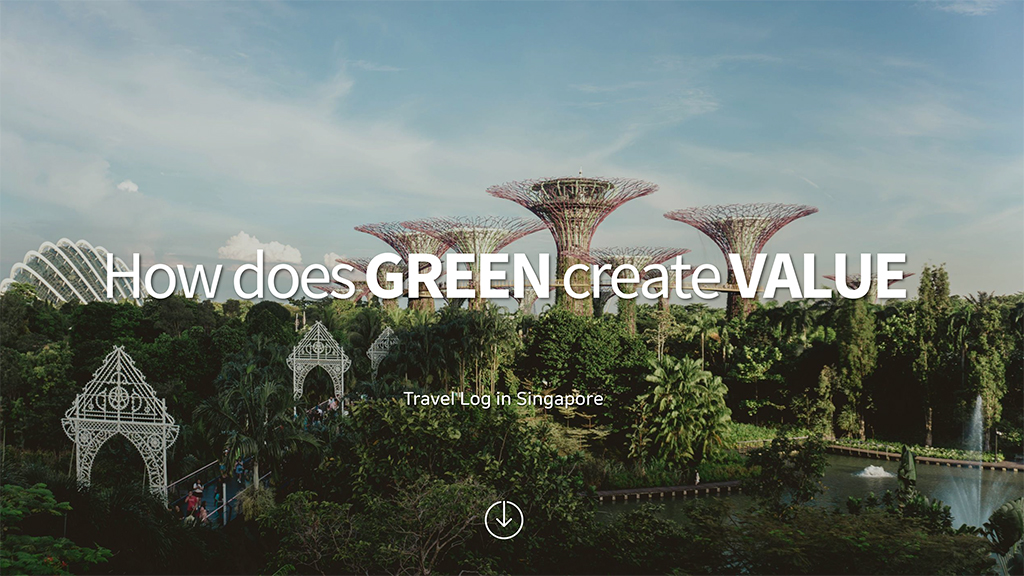
How does GREEN create VALUE – Travel Log in Singapore
Dec. 11, 2024
Preface
This travel log documents a shared journey undertaken by four professionals – a group comprised of architects, an urban planner, and a landscape architect who sought to delve into the innovative application of greenery in Singapore’s built environment our exploration spanned diverse scales and typologies from towering green facades and immersive sky gardens to thoughtfully designed city parks and national gardens. Each site offered unique insights into how green infrastructure contributes to the urban experience, blending environmental sustainability with the creation of vibrant, livable spaces. Singapore, renowned globally as a “City in a Garden,” presents a model of how urban greenery is not merely ornamental but a key driver of value in dense, dynamic living environments. The places we visited and the discussions we held with practitioners reveal a city where green infrastructure bridges the gap between architecture, urban planning, and landscape design, offering lessons on sustainability, aesthetics, and community engagement. Through these visits, we gained a deeper understanding of how green infrastructure creates environmental, social, and economic value. Our reflections are enriched by conversations with local experts, fostering a broader perspective on how design disciplines can work collaboratively to envision and implement sustainable urban solutions. We hope this log inspires others to explore the potential of greenery in shaping resilient and beautiful cities.
How does GREEN create VALUE
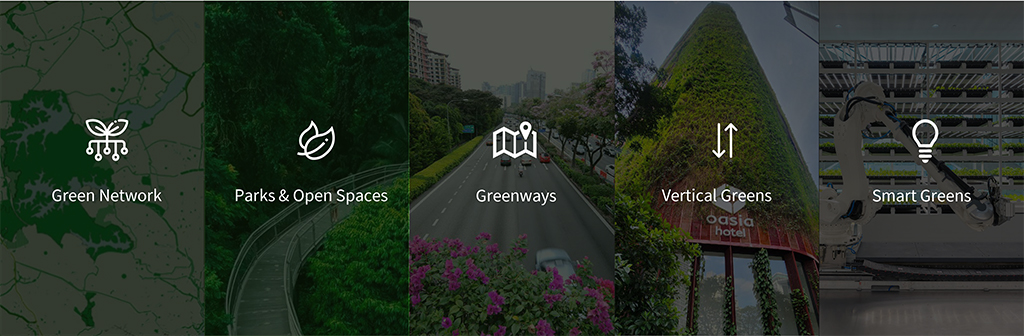
Green Network
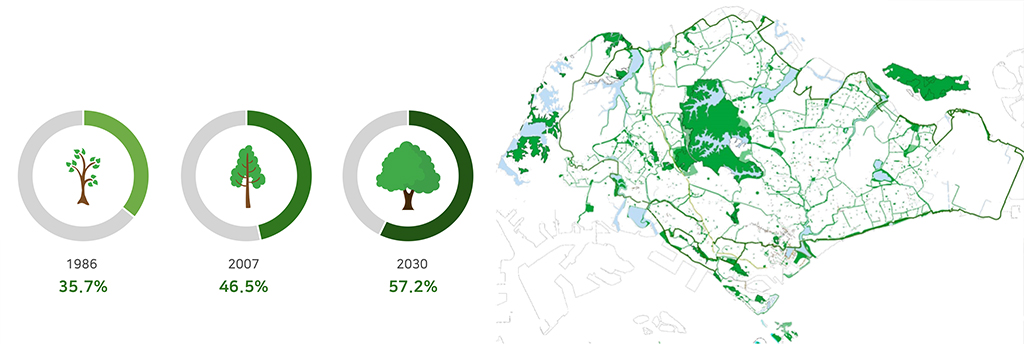
The garden city vision was introduced by the Prime Minister Lee Kuan Yew in 1967 to transform Singapore into a city with lush greenery to create a clean environment for better living. This resulted in over 55,000 trees planted around Singapore by 1970, with the Parks and Trees Act enacted in 1975 to require all developers to set aside spaces for tress and greenery. Today, roadside trees and green buffers are ubiquitous features in cityscape. Given its limited land, Singapore lacks large areas of uninterrupted greenery. These networks connect individual green and blue spaces together to help create a larger sense of contiguous and immersive nature. At the macro level, major areas of greenery and biodiversity are set aside as Nature Reserves. They act as green lungs and provide ecosystem services like clean air and water. Singapore has set aside 4 Nature Reserves and 20 Nature Areas which protect core biodiversity.
Parks & Open Spaces
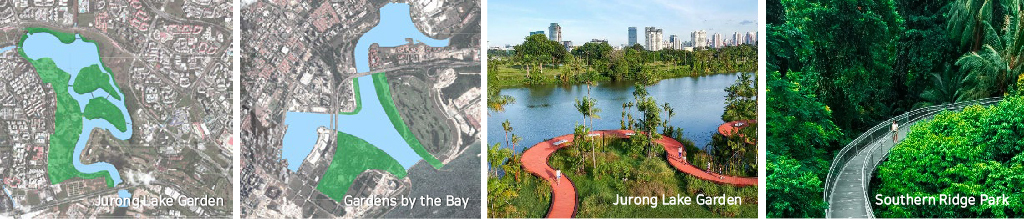
The planners take advantage of geography, topography, and the presence of water to create dramatic, memorable park spaces around the island. This approach also maximizes the functional and aesthetic value of existing forest, hills and waterbodies in the city. Major regional parks like Jurong Lake Gardens and Gardens by the Bay were created around newly created waterbodies in the city while parks like the Southern Ridges were created by connecting the peaks of adjacent hills.
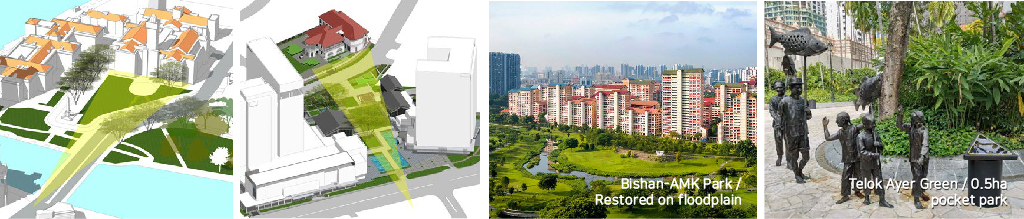
Parks and open spaces are crucial in a highly urbanized city as they provide relief and enhance the well-being of its inhabitants. They act as gathering spaces in the city for activities and chance encounters and support community bonding. Social interaction is also important for the elderly to improve mobility and prevent cognitive decline. By 2030, every household will be within a 10-minute walk to a park.
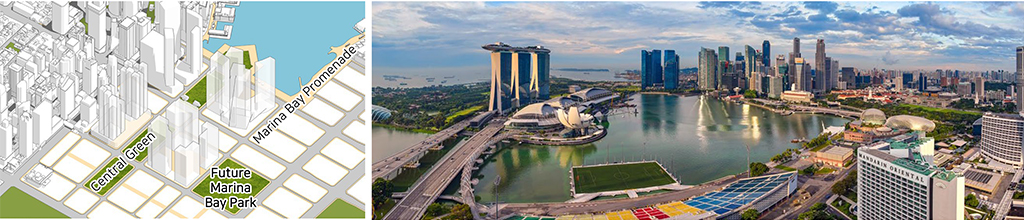
The planners take advantage of geography, topography, and the presence of water to create dramatic, memorable park spaces around the island. This approach also maximizes the functional and aesthetic value of existing context and history to shape identity and create a “Sense of Place”.
Greenways
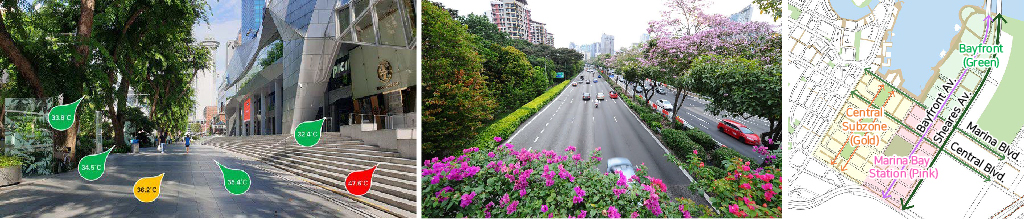
Greenways are represented as thicker green lines on the Parks and Waterbodies (PWB) Plan. Greenways are either created as linear parks or as green fingers cutting through developments. To tackle the challenges of climate change, Singapore is beefing up its network of parks and open spaces connected by greenways to enhance the city’s cooling. Wind corridors have also been introduced in major development areas to facilitate the passive cooling of buildings and public spaces. Adjacent buildings are typically guided to provide human-scale and active frontages to frame promenade spaces sensitively and provide vibrant street life.
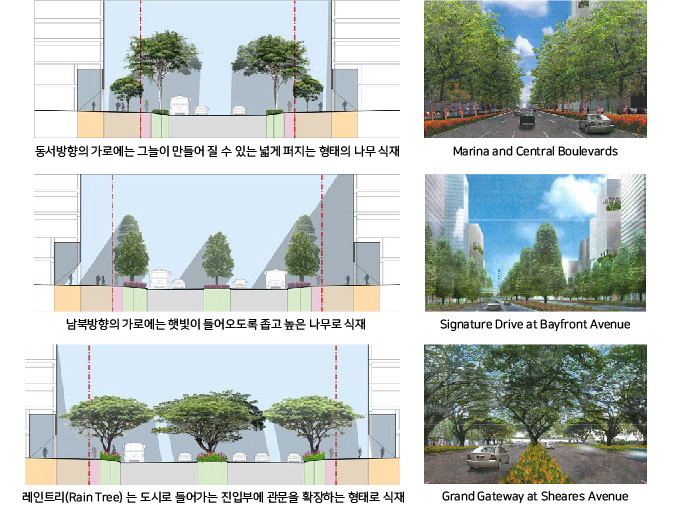
A major contributor of greenery is a roadway with mandatory tree planting within the road space. Landscaping is also used to provide shade and shape the character of roads and streets. Green Buffer planting around the boundary contributes to greenery provision at the development scale. To enhance the visibility of Green Buffers from the street, URA would require boundary fences along some streets to be visually porous. Another strategy is to externalize Green Buffers by setting back the boundary fence behind the green buffer line.
Vertical Greens
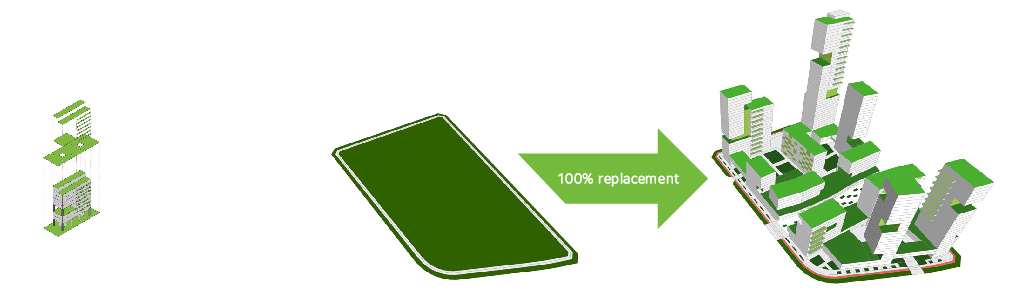
The Landscaping for Urban Spaces and High-Rises policy, also known as “LUSH” plays a key role in creating greenery in developments by requiring landscape replacement. The premise of landscape replacement is simple – developments must create green areas in the building equivalent to the site area so that greenery displaced during development is replaced. This is to ensure that as Singapore continues to urbanize the overall amount of greenery on the island is sustained. Landscape replacement areas comprise a multitude of horizontal and vertical, exterior and interior, exposed and enclosed spaces in a development that can accommodate planting. The total area of these surfaces is added up to meet the landscape replacement area requirement which will vary according to the location of the development.
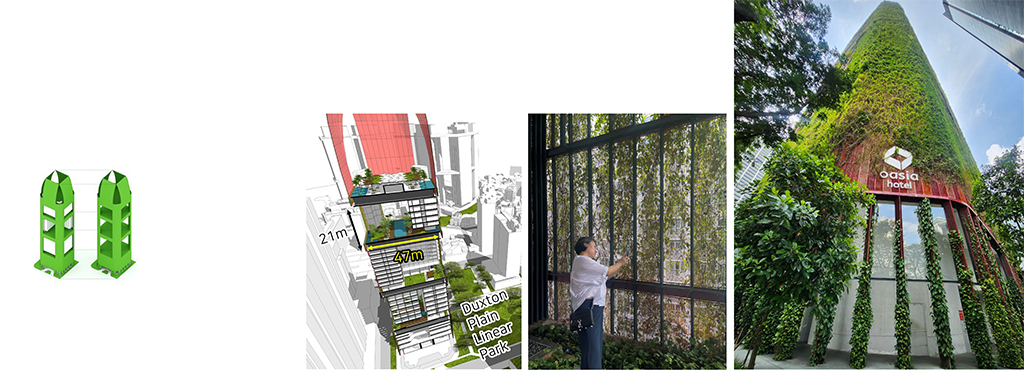
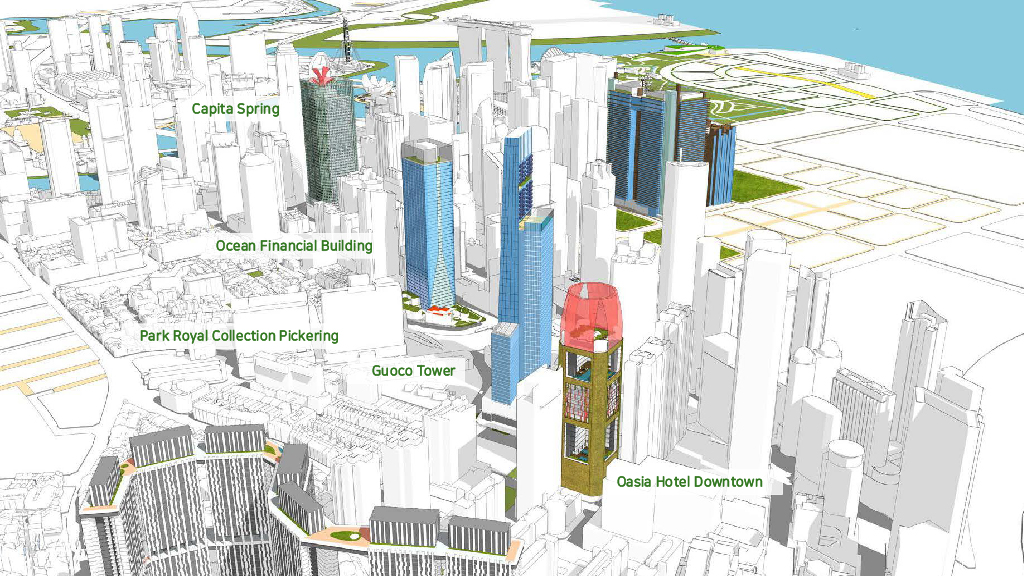
Oasis Hotel is hard to miss landmark with its red mesh façade covered in flowering creepers rising 191m tall next to the park. WHOA Architects designed each sky terrace to occupy almost the full building floor plate with the lift and service cores at the four corners of the building. By this, each sky terrace qualified for additional GFA exemption for residual areas and additional height allowance (15m) under the ‘predominant sky terrace’ incentive, and managed to achieve amount of greenery replacement of over 10 times the site area.
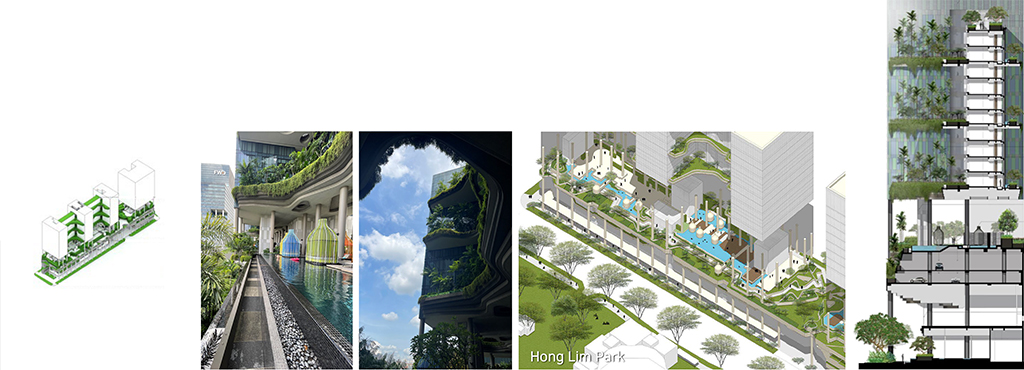
The architects and client were inspired to mirror the creation of greenery on a vertical scale with adjacent Hong Lim park, and would go on to eventually achieve a reported 15,000sqm of greenery within the development double that of the site area. The building treats the tree canopy line as a new datum of greenery in the city on which visually merges with the lushly landscaped podium deck of 5-storey tall to form a human-scale presence along the street with a tiered sculpted façade embellished with planters.
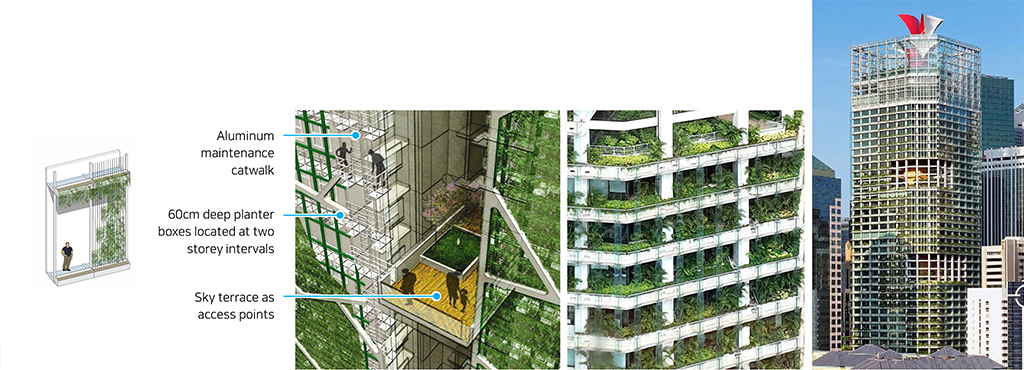
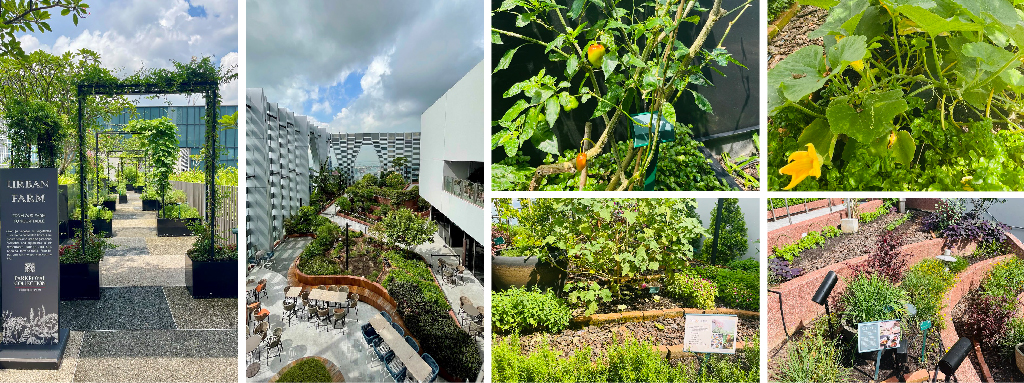
Green walls refer to vertical surfaces of a building that are covered in greenery that work hand in hand with communal planters to green up the building façade. Some have climbing plants with self-clinging roots growing directly on cables or other surfaces. In recent years green walls have evolved to feature more varieties of plants on vertical mounting system sometimes with built-in irrigation. The green wall has cut the building’s carbon footprint by reducing the need for air-conditioning, saving the residents between 15% to 30% of energy usage and over $500,000 in utilities costs a year.
Smart Greens
Acknowledgements
We would like to thank the following persons who welcomed and spare time for sharing stories and insights with us;
- Urban Redevelopment Authority (URA)
Chief Planner / Hwang Yu-Ning - CPG Corporation
Director / Gavin Chan - Park Royal Collection Pickering
Concierge / Christina Wu - Hyundai Motor Group Innovation Center (HMGIC)
Manager / Tommy Liu